
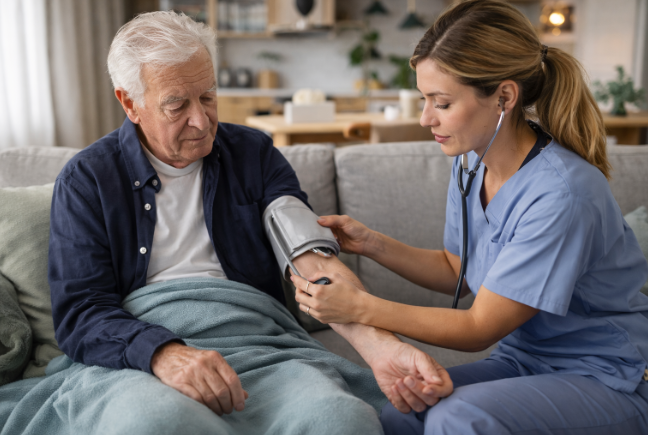
Understanding The Core Difference In Care Settings
In-home nursing and skilled nursing facility placement both provide clinical support, but they operate in fundamentally different environments. In-home nursing delivers medical services within a private residence. A skilled nursing facility provides 24-hour medical oversight in a licensed healthcare setting designed for individuals with ongoing or complex needs.
The decision between the two often depends on the intensity of medical supervision required, the safety of the home environment, and the individual’s ability to perform daily activities. While both models can include licensed nurses and care planning, the structure, staffing availability, and emergency response capacity differ significantly.
Level Of Medical Supervision And Clinical Complexity
One of the most important considerations is how much medical oversight is required on a daily basis. In-home nursing may involve scheduled visits from a registered nurse for wound care, medication management, injections, or monitoring of chronic conditions. Between visits, care may be provided by family members or aides, depending on the arrangement.
In contrast, skilled nursing facilities are designed for individuals who require continuous monitoring, frequent clinical interventions, or complex treatment plans. Residents may need intravenous therapy, post-surgical recovery oversight, feeding tube management, respiratory support, or coordinated rehabilitation services. These settings provide around-the-clock nursing staff and structured clinical supervision.
For individuals whose conditions fluctuate or who are medically unstable, placement in skilled nursing facilities may offer a higher level of ongoing medical oversight than can realistically be maintained at home.
Safety And Environmental Considerations
Home environments vary widely in terms of accessibility and safety. Narrow hallways, stairs, uneven flooring, and limited bathroom modifications can create risks for individuals with mobility challenges. While home modifications can reduce hazards, not all residences can be easily adapted to accommodate wheelchairs, hospital beds, or specialized equipment.
Skilled nursing facilities are purpose-built to reduce fall risk and accommodate medical equipment. Rooms are typically designed for mobility support, and staff are trained to assist with transfers, repositioning, and safe ambulation. In cases where fall risk or physical instability is significant, the controlled environment of a facility can reduce preventable injuries.
Availability Of Rehabilitation And Therapy Services
Rehabilitation needs often influence placement decisions. Individuals recovering from stroke, surgery, or serious illness may require coordinated physical therapy, occupational therapy, and speech therapy several times per week.
In-home therapy can be arranged, but it usually occurs on a scheduled basis and may be limited by insurance coverage or provider availability. Skilled nursing facilities typically integrate therapy services into the daily routine, allowing for more consistent and coordinated treatment plans. For individuals needing structured rehabilitation with measurable progress tracking, facility-based care may provide a more concentrated therapeutic environment.
Caregiver Burden And Family Involvement
In-home nursing often depends heavily on family members or informal caregivers. Even when professional nursing visits are scheduled, day-to-day assistance with meals, hygiene, mobility, and medication reminders may fall to relatives. Over time, this can create physical, emotional, and financial strain.
Skilled nursing facility placement shifts the majority of daily care responsibilities to trained staff. Family members remain involved in care planning and visitation, but are not responsible for direct medical or personal care. In situations where family caregivers are unable to provide consistent support due to work, health, or other obligations, facility-based care may offer a more sustainable structure.
Emergency Response And Medical Escalation
Medical emergencies can occur without warning. In a home setting, response depends on who is present and how quickly emergency services can be contacted. Even with regular nursing visits, there may be periods when no licensed professional is on site.
Skilled nursing facilities maintain continuous staff presence. Changes in condition can be identified and addressed promptly, and physicians or advanced practitioners are typically available for consultation. While emergency transfers to hospitals still occur when necessary, early detection of complications can reduce delays in intervention.
Cost Structures And Insurance Considerations
Financial planning plays a central role in care decisions. In-home nursing costs vary depending on the number of hours required, the level of clinical skill involved, and the duration of services. Limited nursing visits may be covered by certain insurance plans following hospitalization, but extended or around-the-clock in-home care can become costly.
Skilled nursing facility placement may be partially covered under specific conditions, such as post-hospital rehabilitation periods that meet eligibility requirements. Long-term residency often involves private payment or long-term care insurance, depending on individual circumstances. Comparing the full cost of care, including home modifications and caregiver support, is essential when evaluating options.
Social Interaction And Structured Daily Routine
Isolation can affect individuals receiving care at home, particularly if mobility limitations restrict community engagement. While family visits provide interaction, daily social opportunities may be limited.
Skilled nursing facilities typically offer structured daily routines that include meals, activities, and group programs adapted to residents’ abilities. Social interaction is not a substitute for medical care, but it can influence emotional well-being and cognitive stimulation. For individuals at risk of social withdrawal, a structured environment may provide more consistent engagement.
Progression Of Chronic Conditions Over Time
Chronic illnesses often evolve.  A care plan that is manageable at home today may become insufficient if mobility declines, cognitive impairment progresses, or medical complications increase. In-home nursing can be expanded to a point, but there are practical limits to what can be safely delivered in a private residence.
Skilled nursing facilities are structured to accommodate increasing levels of need. As conditions change, care plans can be adjusted without requiring relocation. For individuals with progressive neurological disorders or advanced chronic disease, anticipating future needs is an important part of the decision-making process.
Personal Preference And Quality Of Life Factors
Some individuals strongly prefer remaining at home, valuing familiarity and independence. When medical needs are stable and safety risks are low, in-home nursing can preserve that sense of continuity.
Others may prioritize consistent medical supervision, relief from caregiver strain, or access to on-site therapies. Quality of life considerations are highly individual. A thorough evaluation should include not only medical status but also personal goals, support systems, and the long-term sustainability of each care model.
Clinical Assessment And Care Planning Process
Choosing between in-home nursing and skilled nursing facility placement should involve a structured clinical assessment. This includes reviewing diagnoses, medication complexity, mobility status, cognitive function, fall history, nutritional needs, and the availability of reliable caregivers.
Healthcare providers typically evaluate whether needs can be safely met at home or whether continuous supervision is indicated. The goal is not to favor one setting over the other, but to align the care environment with the individual’s current and anticipated level of medical need. Care planning that accounts for both immediate stability and long-term progression helps reduce avoidable transitions and gaps in support.
Leave a Comment